
No Official Active Warrant List in Virginia Beach
This is the first thing to understand about a Virginia Beach warrant search. No official Virginia Beach Sheriff or court page publishes a general list of active warrants. The Sheriff's Office runs an inmate lookup for people currently or previously held, not a warrant database. Warrants are issued through magistrates and the courts, and they usually become visible only after service or arrest, when they show up in court records or jail bookings.
That gap is normal, and it exists for safety and privacy reasons. It also means any website claiming to show a live, complete Virginia Beach warrant list should be treated with caution. The reliable approach is to use the court case systems and the jail roster, then contact the court or the magistrate office for confirmation. The local court site links the Virginia Beach Magistrate Office, which handles warrants, bail, emergency custody and temporary detention orders, and protective order intake.
The magistrate is a key part of the warrant process in Virginia. A magistrate is a judicial officer who reviews complaints, issues warrants and summonses when there is probable cause, sets initial bail, and processes emergency custody and temporary detention orders. Because magistrates work around the clock, they are often the first judicial contact after an arrest. A person who needs to confirm a warrant or arrange to address one will frequently start with the magistrate or the court clerk rather than the Sheriff, since the Sheriff's role is to serve and execute the order rather than to issue it.
How to Check for a Virginia Beach Warrant
Because there is no direct warrant lookup, a Virginia Beach warrant search works by checking the places a warrant shows up. A pending charge often appears as a case in the General District Court or the statewide OCIS system. A served warrant that led to an arrest shows up in the Sheriff's inmate lookup. Pull together the full name and date of birth before you start, and try name variations if a search comes back empty.
- Search the General District Court system and the statewide OCIS by name for pending criminal or traffic cases.
- Check the Virginia Beach Sheriff's Office inmate lookup for a recent arrest or booking.
- Contact the court or the Virginia Beach Magistrate Office to confirm a warrant.
- If you know a civil case number and a last name, use the Sheriff's civil process search for papers served.
- If a criminal or traffic matter is involved, talk to an attorney or the public defender before acting.
A missed court date is a common reason a warrant gets issued. The court dockets page explains how to confirm an upcoming hearing so you do not miss it.
Types of Virginia Beach Warrants
Not every warrant means the same thing. The word covers several different court papers, and knowing which one applies changes how you respond. Some are criminal, some are civil, and some are not public until they are carried out.
- Arrest warrant
- An order to arrest a person based on a criminal complaint and probable cause.
- Bench warrant or capias
- Issued by a court, often after a missed court date or a violation.
- Search warrant
- Authorizes a search or seizure, and is usually not public before it is executed.
- Fugitive warrant
- Relates to a person wanted in another jurisdiction.
- Civil warrant or summons
- A General District Court civil paper, such as a warrant in debt, which is not an arrest warrant.
Protective orders are handled separately. Emergency, preliminary, and final protective orders are excluded from the General District Court online case system, so they will not appear in an ordinary online search.
Virginia Beach Sheriff Civil Process Search
The Sheriff's Office serves civil papers, and it offers a search for papers it has handled. This is not an arrest warrant lookup. It is a way to confirm that a civil paper, such as a subpoena or a civil warrant, was served by the Sheriff. The search is strict: you must know both the case number and the last name of a person tied to the paper. That person may be the plaintiff, the defendant, or a deponent.
| Field | Type | Required | Notes |
|---|---|---|---|
| Case Number | Text | Yes | You must know the exact case number |
| Last Name | Text | Yes | Plaintiff, defendant, or deponent on the paper |
| Proceed to Search | Button | n/a | Starts the search form |
If you do not have the case number, the civil process search will not help, and the right step is to contact the court that issued the paper. The Sheriff's civil process search is run by the Virginia Beach Sheriff's Office.
You confirm served civil papers on the VBSO civil process paper search, which needs both a case number and a last name.
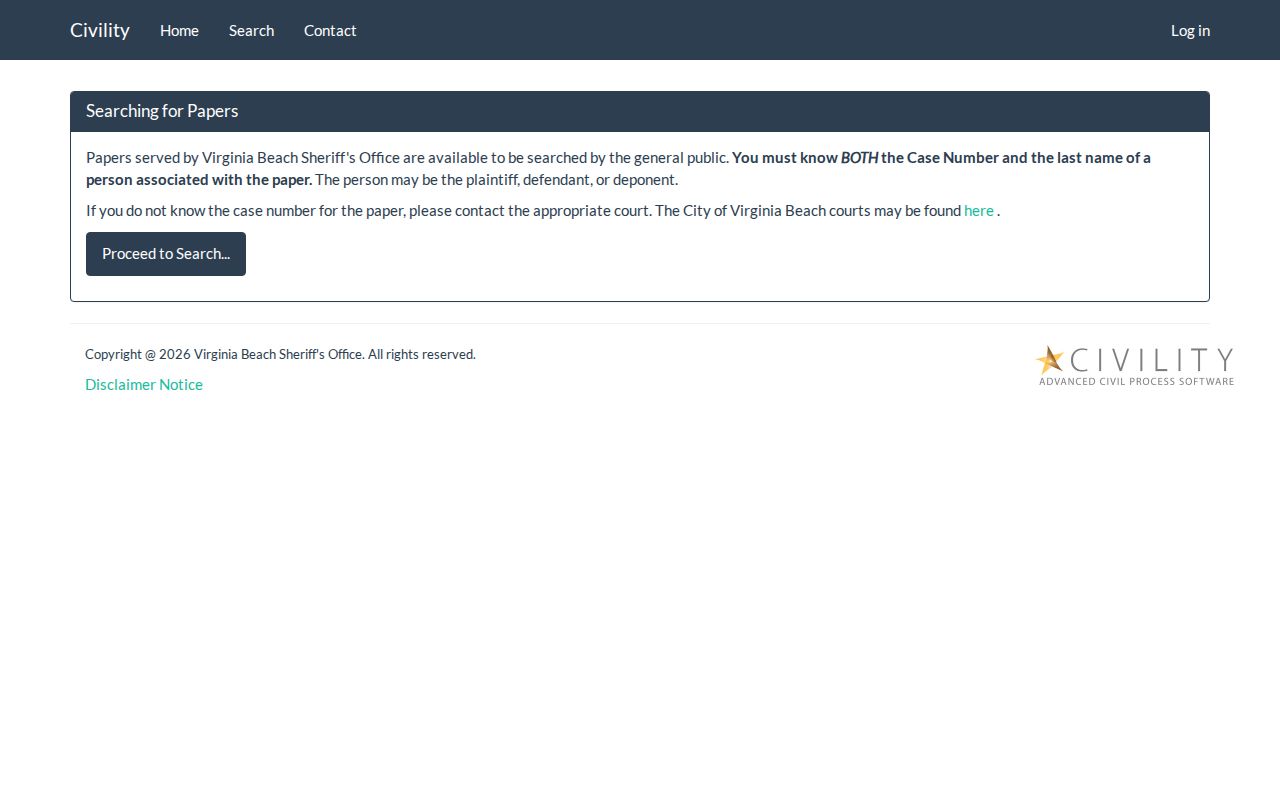
This tool tracks civil papers the Sheriff served, not arrest warrants, so use it only when you already have the case number.
Civil process and arrest warrants are easy to confuse, but they work in different worlds. A civil warrant in debt or an unlawful detainer is a General District Court civil filing that starts a lawsuit. It does not order anyone's arrest. An arrest warrant is a criminal order. The Sheriff serves both kinds of papers, yet only the criminal warrant leads to booking at the jail. When you are checking on a "warrant," it helps to know which type you are dealing with, because the search path and the response are not the same.
What a Virginia Beach Warrant Record Shows
When a warrant does become visible, usually after service or arrest, the related case and booking records carry the useful detail. There is no single warrant screen with a fixed set of fields, but the records connected to a warrant generally include the items below.
- The person's name and identifying details on the booking record.
- The case number and the court handling the matter.
- The charge or the reason the warrant was issued.
- Bond information, including type, amount, and who set it.
- The next hearing date once the case is on a docket.
For the full booking profile and bond table, see the Virginia Beach inmate records page. For the underlying case, use the court records page.
Watch for Warrant and Jury Duty Scams
Scams tied to warrants are common, and the Sheriff's Office warns about them on its homepage. Scammers impersonate deputies and claim a person owes money for a missed jury summons or an outstanding warrant, then demand immediate payment to avoid arrest. The Sheriff's Office says plainly that it will never ask you to pay money to avoid arrest.
Important: No real Virginia Beach deputy will call and demand payment over the phone to clear a warrant. Hang up and confirm any warrant directly with the court or magistrate.
Bench Warrants and Failure to Appear in Virginia Beach
One of the most common ways a Virginia Beach warrant gets issued is a missed court date. When a person does not appear as ordered, the court can issue a bench warrant or a capias, which is a court order to bring the person in. This can happen in a traffic case, a criminal case, or even a civil matter where appearance was required. A capias does not always mean new criminal conduct. Often it simply reflects a missed hearing, and clearing it may be as direct as appearing before the court and explaining the absence.
The practical risk is that a person may not know a bench warrant exists until a routine traffic stop or a background check turns it up. That is why checking pending cases matters. If a case shows an unresolved status or a failure to appear in the General District Court or OCIS systems, treat it seriously and contact the court right away. A prompt, voluntary appearance is usually viewed more favorably than waiting for an arrest. The longer a capias sits unaddressed, the more it can complicate a license, a bond, or a later case.
How to Resolve an Outstanding Virginia Beach Warrant
If a warrant is real, handling it through official channels is the safe path. Acting quickly and with legal help usually leads to a better outcome than waiting. The steps below outline a careful approach.
- Confirm the warrant through an official court or law enforcement source, not a third-party site.
- Do not pay anyone who calls claiming a phone payment will stop an arrest.
- Contact an attorney or the public defender if a criminal or traffic case is involved.
- If represented, let your attorney arrange a surrender or a court hearing.
- If turning yourself in, confirm the time and place with the court, magistrate, or Sheriff, and expect booking and a bond review.
- After the matter is resolved, check the case portal and any license or DMV consequences if it was traffic related.
Once a warrant is resolved, follow up to make sure the record reflects it. Ask the court whether the case shows the warrant cleared, and check the case in the online portal after a few days. If the matter touched a driver's license, confirm the status with the DMV as well, since a court resolution and a DMV update are separate steps. Keeping copies of any orders or receipts protects you if a question comes up later.
For DUI, DWI, and other serious traffic warrants, see the traffic court records and arrest records pages.