
How Virginia Beach Probate Records Work
Probate in the City of Virginia Beach is handled by the Circuit Court Clerk, not a separate probate court. Virginia does not have stand-alone probate courts. Instead, the Clerk's Probate and Wills Division does the work. The official page defines probate as the official proof of the will as the authentic and valid last will and testament of the deceased. In most cases the deputy clerk handles the matter, and a Circuit Court judge is not involved at all.
Probate is by appointment only. The office asks that you call the Probate Department before coming in, because a deputy clerk gives specific instructions based on the estate. That call saves a wasted trip. Estates differ, and the documents you need vary, so the staff walk you through what applies to your situation before you arrive.
Not every estate needs formal administration. A small estate may pass outside full probate, and several kinds of property move directly to a survivor or beneficiary. The Clerk's Office also records the will and connects it to the city's land records. For the broader office and its other duties, see the Clerk of Circuit Court page, and for marriage and divorce files held by the same office, see the marriage and divorce records page.
It helps to separate two ideas at the start. Probating a will means proving the will and getting it recorded. Qualifying as a fiduciary means being appointed to manage and settle the estate. The two often happen together, but not always. A will can be proved and recorded without a full appointment in some cases, while other estates need someone with legal authority to act. The deputy clerk sorts out which path a given estate follows during the appointment.
The Clerk lays out the full steps and taxes on the official Virginia Beach probate process and taxes page before you set an appointment.
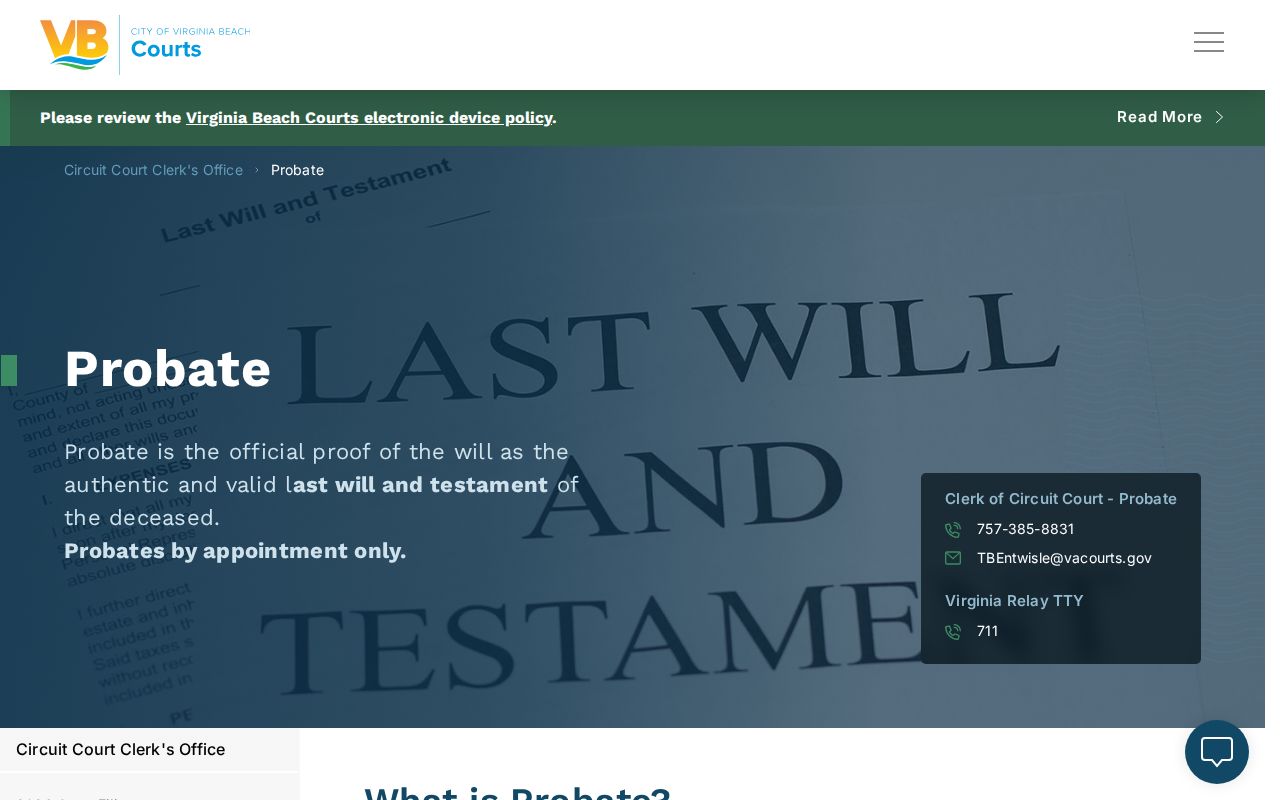
That page defines probate, lists the tax rates, and explains why the Probate and Wills Division works by appointment only.
Virginia Beach Probate Office Contact
The Probate and Wills Division sits within the Clerk's Office at the Municipal Center. Because probate is by appointment, the phone is the first step. A deputy clerk sets the appointment and tells you what to bring. The contact card below lists the division's direct line and page.
Clerk of Circuit Court - Probate
2425 Nimmo Parkway, Building 10
Virginia Beach, VA 23456
757-385-8831
By appointment only
There is no set time frame to probate a will or to begin administration. The office does not impose a hard deadline to start, though questions about timing should go to an attorney or the Clerk. When you call, have the basic facts ready: the decedent's name, the date of death, and a rough idea of the estate's assets and value.
Virginia Beach Probate Terms Explained
Probate has its own vocabulary, and a few words come up in almost every estate. Knowing them makes the process and the records easier to read. The definitions below cover the terms the Clerk's probate page uses most.
- Testator
- A person who dies leaving a valid will. A person who dies testate left a will.
- Executor
- The person named in a will to settle the estate and carry out its terms.
- Administrator
- The person the court appoints to settle an estate when there is no will or no named executor.
- Intestate
- Dying without a valid will. State law then decides who inherits.
- Fiduciary
- An executor or administrator who must act in the estate's best interest and follow strict duties.
- Commissioner of Accounts
- The court-appointed official who reviews and approves the fiduciary's inventory and accountings.
These terms run through the records. A probate file may name a testator and an executor, or it may show an administrator handling an intestate estate. The commissioner of accounts signs off on the numbers along the way.
Virginia Beach Probate Tax and Fees
Probate carries a tax based on the value of the estate, paid at filing. Virginia Beach charges a state probate tax and a local probate tax, both figured per $1,000 of estate value, plus recording fees. The table below lists the probate tax rates from the official probate page.
| Item | Rate |
|---|---|
| State probate tax | $1 per $1,000 of estate value |
| Local probate tax | $0.33 per $1,000 of estate value |
| Recording fees | Additional; amount not listed on the official page |
An example makes the math clear. On a $50,000 estate, the state tax is $50 and the local tax is $16.67. Recording fees come on top of that, and the official page does not list a set amount for them. Executor or administrator compensation is allowed, but it must be approved by the commissioner of accounts rather than taken freely. Ask the Probate Division for a full cost estimate when you set the appointment.
The tax scales with the estate, so a larger estate owes more. The rates stay the same per $1,000, but the total rises as the value climbs. That is why the deputy clerk wants a value figure before the appointment. The probate tax is due at filing, not later, so plan to have the payment in hand on the day you qualify. Recording fees apply when the will or related papers are recorded, and the office can quote those when you call.
What to Bring to a Virginia Beach Probate Appointment
Coming prepared keeps the appointment short. The deputy clerk needs the will, proof of death, and a working picture of the estate. The items below are the core of what the office expects.
- The original will, not a copy, if the decedent left one.
- A copy of the death certificate.
- Knowledge of the estate's assets and their values.
- Payment for the probate tax and recording fees.
If you are not sure of every asset value, the deputy clerk can guide you, but a rough total is needed to figure the probate tax. The call before the appointment is the time to ask what else your specific estate requires. Some estates need more, some less, and the office tailors the instructions to the facts.
The original will matters because the office must inspect the real document, not a photocopy. If the original cannot be found, the process changes, so raise that on the call. The death certificate copy proves the death and the date, which the office records. Pull together a list of the major assets too: bank accounts, real estate, vehicles, and any life insurance. You do not need exact figures down to the dollar, but a reasonable estimate of total value lets the deputy clerk compute the probate tax and tell you the full cost before you commit.
Executor and Fiduciary Duties in Virginia Beach Probate
Once appointed, an executor or administrator becomes a fiduciary with real duties. The role is not a formality. A fiduciary must take possession and control of estate property, determine the debts and liabilities, value the assets, pay debts and taxes, and distribute or sell property according to the will or the law. Two deadlines stand out and trip up people who do not plan for them.
The fiduciary must file an inventory within four months with the commissioner of accounts. Within 30 days after qualification or probate, the fiduciary must give written notice to the heirs and beneficiaries. After that, the fiduciary makes an annual accounting and keeps doing so until the final account is filed and approved. The commissioner of accounts reviews each step. Missing these deadlines can create problems, so a fiduciary should mark them right away.
A will may be proved and recorded without full formal administration in some cases. Qualification and administration are needed where the assets require fiduciary authority to manage or transfer. The deputy clerk explains which path fits a given estate.
Intestate Succession and Small Estates
When a person dies without a valid will, state law decides who inherits. In broad terms, everything goes to the surviving spouse unless there are children or descendants from someone other than that spouse. In that case, the spouse takes one-third and the children take two-thirds. If there is no spouse, the estate passes to the children or their descendants. If none, it goes to the parents, then to siblings and their descendants, with further rules in the statutes.
Many estates never need full probate. Small estates, certain government, occupational, and banking payments, a paid-off vehicle's title transfer, joint accounts with survivorship, life-insurance proceeds to a named beneficiary, and survivorship real estate can all pass outside formal administration. Virginia's small-estate rules sit in Va. Code § 64.2-443, which allows distribution by affidavit in qualifying cases. Ask the Probate Division whether an estate clears the small-estate path before assuming full administration is needed.
The small-estate path can save real time and cost. Where it applies, an heir or successor may collect property by affidavit instead of opening a full estate. It does not fit every case, and there are limits on what qualifies, so it is not a guess to make on your own. A quick call to the Probate Department settles it. The deputy clerk can tell you whether the assets and value fit, and what document the successor needs to sign and present.
Virginia's small-estate affidavit rule lives in Va. Code § 64.2-443, which lets a successor collect property without full probate.
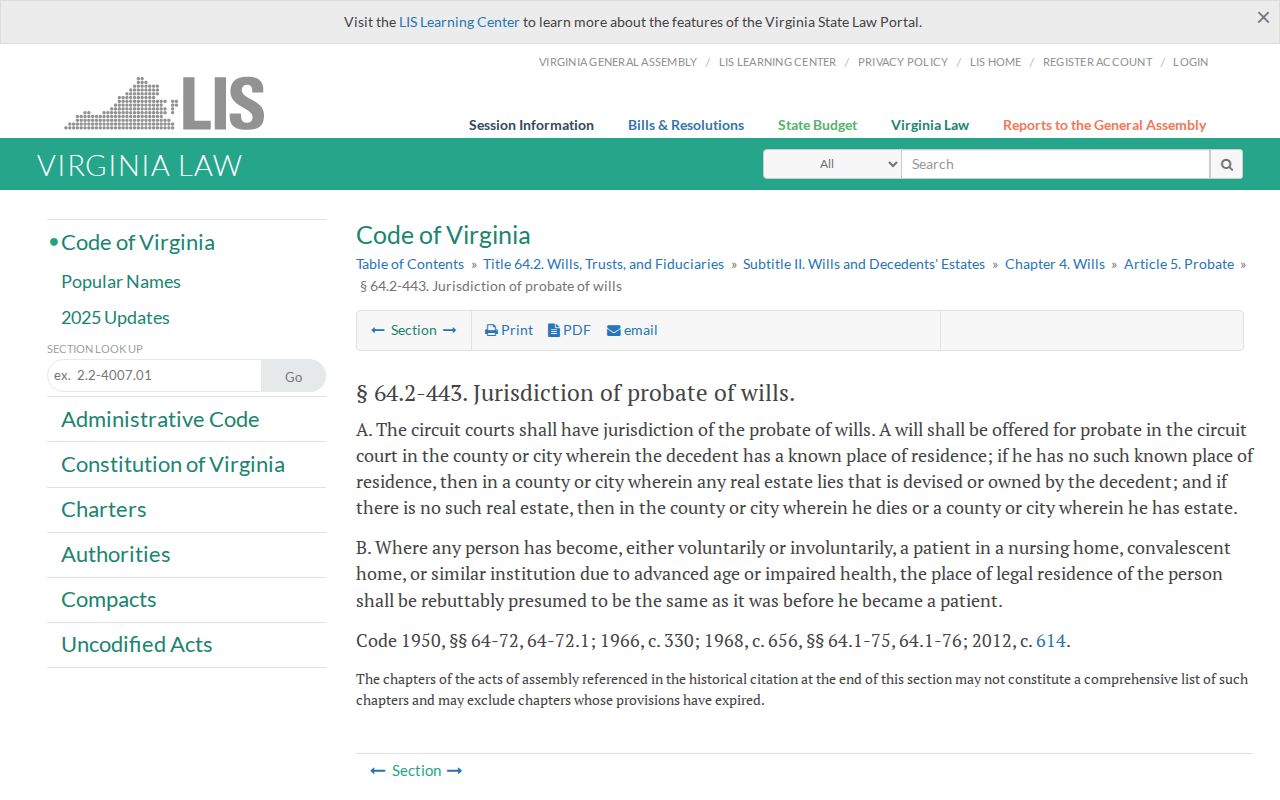
The statute sets the limits on what qualifies, so read it alongside a quick call to the Virginia Beach Probate Department.
Venue also matters for where probate happens. The estate is handled in the city or county where the person lived, or where they owned real estate, with further rules if neither applies. For a Virginia Beach resident, that points to the Virginia Beach Clerk. If the decedent lived elsewhere but owned property here, ask the office whether Virginia Beach is the right place to file.
Note: An interested person may appeal to a Circuit Court judge within six months of the deputy clerk's order admitting a will to probate.
Accessing Virginia Beach Wills and Probate Land Records
Recorded wills and related probate land records connect to the Clerk's land-record system. The state case-information hub lists wills under Secure Remote Access to Land Records, which is a registered system rather than the free public portal. To use it, a person must register with the local Circuit Court Clerk. That access is aimed at title searchers, attorneys, and others who pull land records regularly.
For a single will or estate file, you do not need the remote system. Request a public or certified copy directly from the Probate and Wills Division. Plain copies at the Circuit Court level run $0.50 per sheet, and certifying an order costs $2.00. For the office details and the full fee list, see the Clerk of Circuit Court page. For full case files and the public case portals, see the Virginia Beach court records page.
When you request a copy, bring or send the decedent's name and the year of death so staff can find the file. A certified copy carries the Clerk's seal and is the version a bank, a court, or another agency usually wants. A plain copy is fine for personal reference but may be refused where proof is needed. The Probate Department line, 757-385-8831, is the place to confirm what a given file holds and what a copy will cost before you make the trip or mail the request.