
Virginia Beach District Court Overview
Virginia Beach has two district courts, and they are limited-jurisdiction courts. That means each one handles only the case types the law gives it. The General District Court takes traffic, misdemeanors, felony preliminary hearings, bond hearings, and civil claims up to set limits. The JDR Court takes juvenile cases and family matters. Neither court is a court of record, so cases appealed from them get a fresh hearing in the Circuit Court.
Both courts share the judicial complex on Nimmo Parkway, but they sit in different buildings. The General District Court is in Building 10. The JDR Court is in Building 10A. Each court has its own clerk, its own phone lines, and its own copy rules. That split matters when you request records. A traffic case copy comes from the General District Court Traffic Division, while a juvenile file is handled by the JDR Clerk with proper identification.
The district courts feed the larger system. A serious criminal charge may start in the General District Court as a felony preliminary hearing, then move up to the Circuit Court after indictment. For the court of record and its files, see the Virginia Beach Circuit Court page. For broad case lookups, the Virginia Beach court records page covers all three courts.
Why does the city run district courts instead of county courts? Virginia Beach is an independent city, not a county. For court purposes, though, the city works just like a locality in the statewide court system. There is one General District Court and one JDR Court for the city, and the same Nimmo Parkway complex holds both. The state judiciary supplies the case systems, the schedules, and the judge assignments. So the local pages and the statewide portals both point to the same files.
Virginia Beach General District Court
The General District Court is the high-volume court in the city. It handles three main groups of cases. The traffic division takes citations and prepayable tickets. The criminal division takes misdemeanors, felony preliminary hearings, and bond hearings. The civil division takes warrants in debt, unlawful detainers, and small civil claims. The court sits on the first and second floors of Building 10 at the Judicial Center.
Civil cases split by dollar amount. The General District Court has sole authority over civil claims of $4,500 or less. It shares the range from $4,500 to $25,000 with the Circuit Court. In personal injury and wrongful death cases, the court can hear claims up to $50,000. Above those limits, a case belongs in Circuit Court.
Virginia Beach General District Court
2425 Nimmo Parkway, Building 10
Virginia Beach, VA 23456-9057
757-385-8531
Mon–Fri 8:00 a.m.–4:00 p.m.
Telephone operators are on duty from 8:00 a.m. to 3:30 p.m. Fines and court costs on prepayable offenses may be paid at the Accounting Office or online through the Virginia judiciary. For traffic citations in detail, see the Virginia Beach traffic court records page.
The criminal division and the civil division work apart from each other. The criminal side handles misdemeanors and the early stages of felony cases, sets bond, and tracks court dates. A felony preliminary hearing here decides only whether there is enough cause to send the case to the Circuit Court. The civil side handles warrants in debt, landlord-tenant and unlawful detainer cases, and small claims. Each division has its own fax line for continuances, and each keeps its own copy rules. So the right line and the right office depend on the kind of case you are tracking.
The state judiciary keeps a Virginia Beach General District Court records listing with the court address, hours, and division contacts.
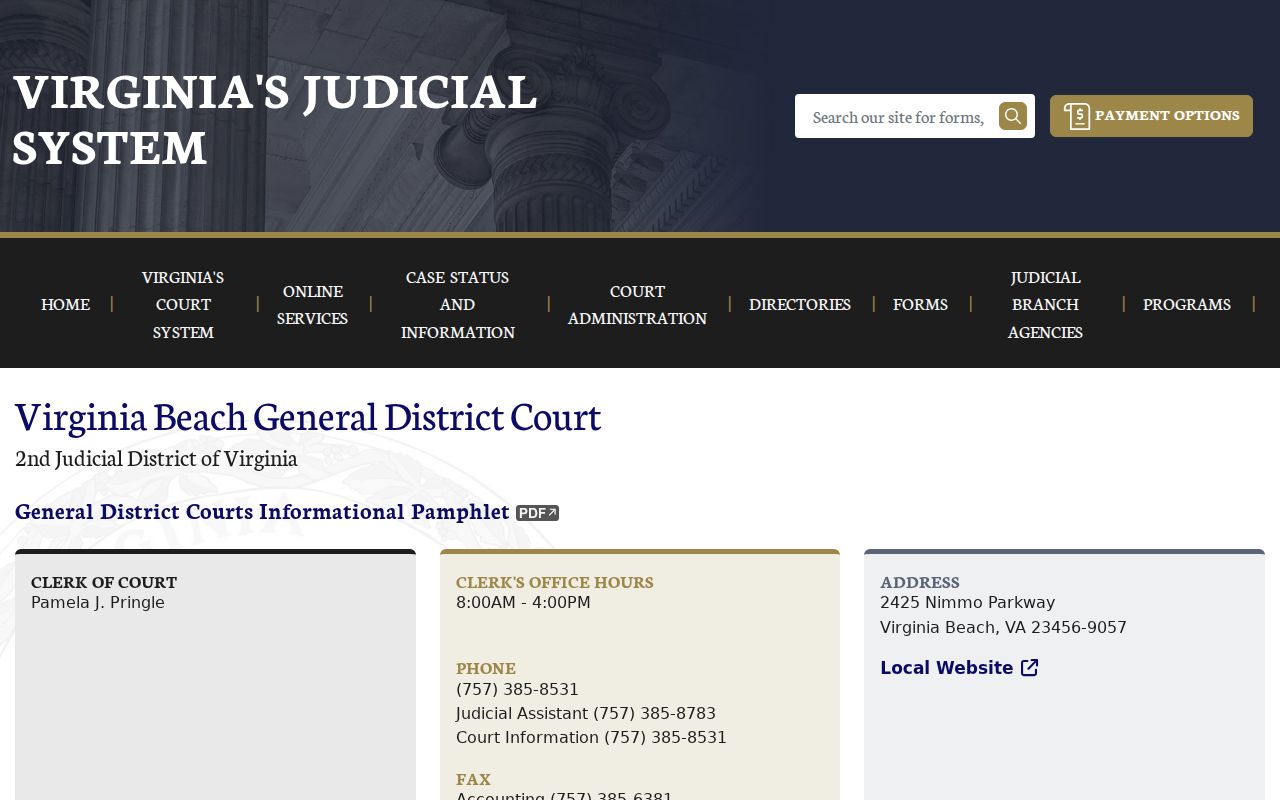
It is the official state page for the court, so it is a reliable check on phone lines and the Building 10 location.
General District Court Judges
A chief judge leads the General District Court bench, with several other judges hearing cases across the divisions. The Hon. Sandra S. Menago serves as Chief Judge. The other sitting judges named on the local court page are listed below.
- Hon. Wanda J. Cooper
- Hon. Elizabeth S. Foster
- Hon. Vivian F. Henderson
- Hon. Aaron F. Kass
- Hon. Daniel R. Lahne
- Hon. Paul D. Merullo
Judges hear cases, but they do not hold the files. The court clerk keeps the records and makes copies. If you need a case file or a docket, you contact the clerk's office, not a judge.
Virginia Beach JDR Court
The Juvenile and Domestic Relations District Court handles cases that touch children and families. Its work covers custody, visitation, child and spousal support, parentage, abuse and neglect, and foster care. It also hears family abuse petitions and certain adult criminal matters where the people involved are family or household members. Juvenile delinquency cases are heard here too.
JDR records are different from ordinary public records. Juvenile files are confidential under Virginia law. The JDR copy page says juvenile dispositions are not given over the phone to the public, and juvenile inquiries require proper identification. Adult criminal dispositions in JDR are open and may be provided by phone if available. That split is why a parent or attorney may need to show ID while a general searcher sees nothing online.
The state judiciary also runs a Virginia Beach JDR Court records listing with the court contact and the Building 10A address for family cases.
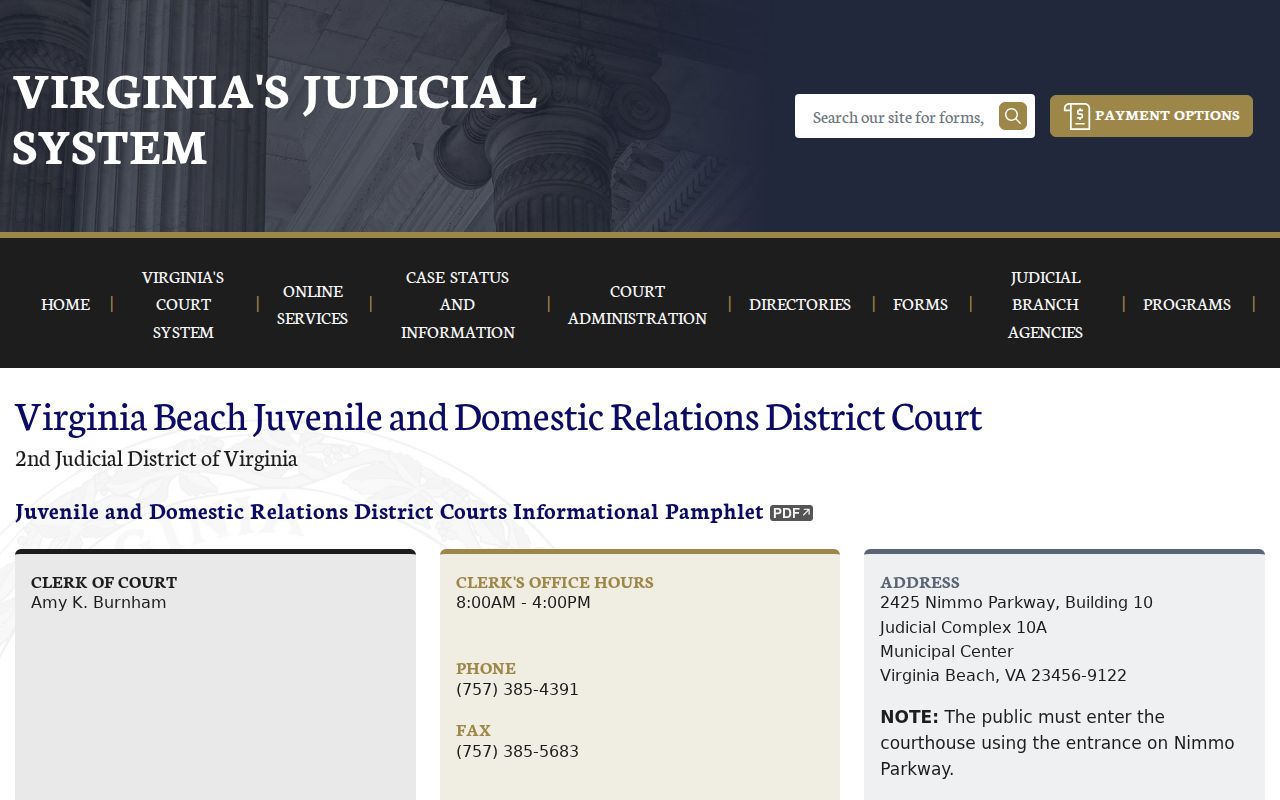
The official listing confirms the JDR phone line and shows how the family court differs from the General District Court.
Virginia Beach JDR District Court
2425 Nimmo Parkway, Building 10A
Virginia Beach, VA 23456-9122
757-385-4391
The JDR page notes a local access detail: the public must enter the courthouse using the entrance on Nimmo Parkway. Protective orders and civil commitment matters are not available through the public online case system.
The JDR Court also touches driver licensing in a small way. The court waived the ceremony requirement for newly licensed drivers, and the DMV now mails licenses to new drivers. Juvenile traffic cases are heard here on Fridays. For an adult traffic ticket, though, the case belongs to the General District Court Traffic Division, not the JDR Court. That distinction trips up parents who assume every young driver's ticket lands in juvenile court.
For copies, the court posts a Virginia Beach JDR Court records copy request page that covers what is given by phone and what needs ID.
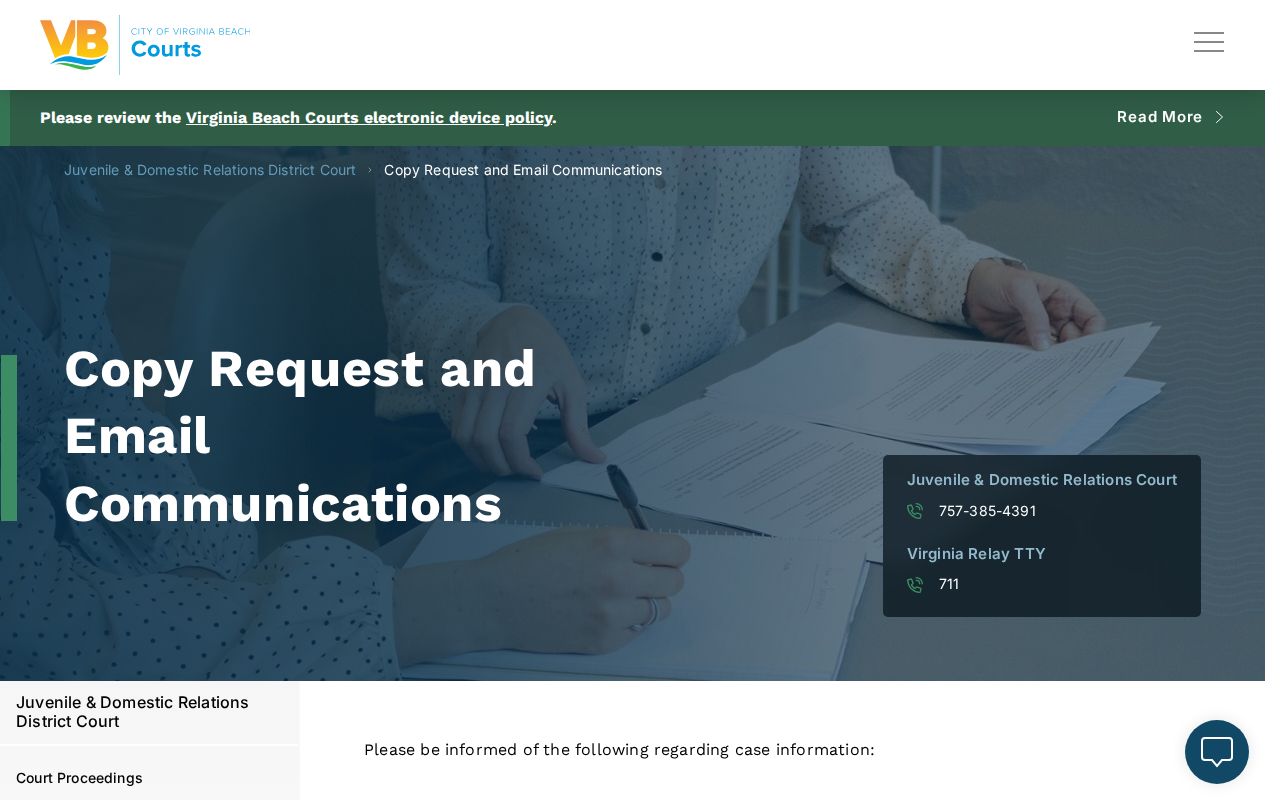
The page makes clear that juvenile dispositions are not handed out over the phone, while adult criminal results may be.
Comparing the District Courts and Circuit Court
Knowing which court holds a case saves a lot of time. Each court takes a different slice of the docket. The table below sets the General District Court, the JDR Court, and the Circuit Court side by side.
| Feature | General District Court | JDR Court | Circuit Court |
|---|---|---|---|
| Main cases | Traffic, misdemeanors, small civil | Juvenile and family matters | Felonies, divorce, larger civil, appeals |
| Civil limit | Sole up to $4,500; up to $50,000 PI/wrongful death | Support and family finances only | Larger civil; shares $4,500 to $25,000 |
| Records access | Adult records generally public | Juvenile files confidential | Public unless sealed |
| Court of record | No | No | Yes |
The court-of-record difference drives the appeal path. Because the district courts keep no formal permanent file, an appeal gets a brand new hearing in Circuit Court rather than a review of a transcript.
JDR Court Weekly Schedule
The JDR Court runs on a set weekly schedule from the state judiciary page. Knowing the time blocks helps you plan a court date or find when a case type is heard. The schedule below shows the standard times.
| Matter | Day | Time |
|---|---|---|
| Adult arraignments | Monday to Friday | 8:00 a.m. |
| Juvenile arraignments | Monday to Friday | 8:30 a.m. |
| Bond hearings | Monday to Friday | 9:00 a.m. |
| Adult video arraignments | Monday to Friday | 9:30 a.m. |
| Motions | Monday to Friday | 10:30 a.m. |
| Juvenile traffic | Friday | 9:00 a.m. |
The adult video arraignments are held with the jail. Times can shift for holidays or special settings, so confirm your own court date on the summons or through the case portal before you go.
Note: Juvenile traffic matters may be heard in the JDR Court on Fridays, while adult traffic citations go through the General District Court Traffic Division.
How to Search Virginia Beach District Court Records
District court case information lives in the statewide Virginia judiciary system. The main tool for the General District Court is the General District Court Case Information system. It covers civil, criminal, and traffic cases, and it is the system that takes online payments for prepayable charges. You must select Virginia Beach first, before you search.
- Open the General District Court Case Information system and accept the terms.
- Select Virginia Beach General District Court before searching.
- Choose Name Search, Case Number Search, or Hearing Date Search.
- Enter a last name with at least two characters, or a valid case number.
- Pick a data status of Current, Archived, or All.
- Open a result to view the case, charges, hearing dates, and disposition.
If the system rejects your search, first confirm a court is selected. Then confirm the name has at least two characters or the case number fits the court's format. The statewide Online Case Information System also searches adult criminal and traffic cases across courts. Juvenile cases, protective orders, and civil commitment matters are not in the public online system. For hearing dates, see the Virginia Beach court dockets page.
The data status field is worth a second look. Search Current first for active and recent cases. Switch to Archived for older matters, and use All when you are not sure. The court does not publish a fixed archive cutoff, so an empty Current result is a prompt to widen the search rather than proof that no case exists. Older files may still need a call or a visit to the clerk, because the online index does not always reach as far back as the paper file.
Continuances and Traffic Appeals
The district courts have firm rules on continuances and appeals. A continuance is a request to move a court date. The General District Court takes these in person or by fax, and a written request must be signed. The court warns there is no guarantee a continuance will be granted, and it will not call you with the judge's decision. The civil fax is 757-385-5682, the criminal fax is 757-385-1065, and the traffic fax is 757-385-1063.
Traffic appeals run on a tight clock. To appeal a traffic conviction, the defendant or attorney must appear in person at the Traffic Division Office within 10 calendar days of conviction. After 10 calendar days, the right to appeal is lost. An appealed traffic case may then create a Circuit Court record on top of the original General District Court disposition. For the full traffic process, see the traffic court records page, and for help getting certified copies, the Clerk of Circuit Court page covers court-of-record requests.
A few practical points help with any continuance request. The court will not contact you with the judge's decision, so you must follow up yourself. Telephone requests are not accepted at all. A written request must be signed and must include the present court date and the reason. If you want a public defender, you appear at the Criminal Division or Traffic Division no later than 10 calendar days before court to see if you qualify. Already-appointed clients call the Public Defender's Office at 757-427-6050.
If you cannot afford a lawyer, the Virginia Beach General District Court records public defender page explains how to ask the court to qualify you.
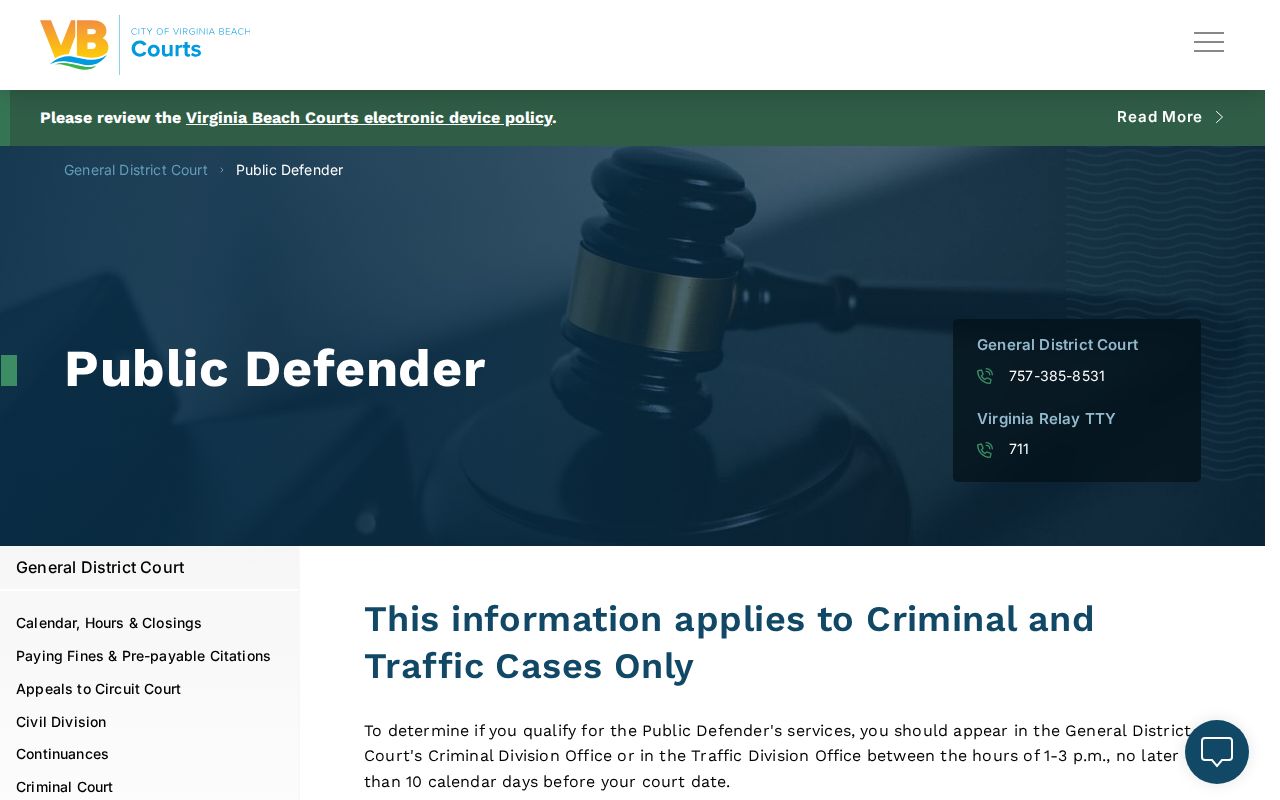
It lists the deadline to appear and the office contact, so you know when to show up before your court date.
Prepayment is its own path. If an offense is prepayable, you can settle the fine and court costs at the Accounting Office or online through the Virginia judiciary, and a schedule of prepayable fines is posted online. Prepaying may count as an admission for some offenses, so check the consequences before you pay. Non-prepayable offenses require a court appearance. When in doubt, search the case in the General District Court system and confirm the court date before you decide how to handle the charge.